Support WBUR
Essay
What knitting taught me about how to begin
All metaphors about knitting and writing have already been made: storytellers and knitters both spin yarns, tie up loose ends and hunt for new material. The vocabulary of each is tangled up in the other, underscored by cliché and myth. Still, learning to knit taught me more about writing — and living — than I ever expected.
As a frustrated 26 year-old writer, I began knitting in 2020, at the height of the pandemic. After finishing an MFA, but failing to find a job or publish my stories, I had moved to my grandmother’s house in Queens, bringing my boyfriend with me. My grandmother had moved out, to live closer to my mother, but her things still filled the house. As we settled in among the porcelain figurines and old family photographs, I tried to focus on what I knew to be true: I was lucky to be healthy and safe. Still, I was unemployed and uninspired. Facing writers’ block and overwhelmed by my sense of failure, I found a pair of needles and a ball of cheap acrylic yarn that I’d bought one aspirational, sub-zero winter during grad school. I’d never used them — I barely knew how.
In the dim, cluttered Queens house, I taught myself from YouTube videos, botching techniques. Stitches mysteriously multiplied and disappeared. Purling mystified me. Patterns seemed indecipherable with their abbreviations and numbers, their brackets and asterisks. A familiar frustration — the perfectionist paralysis I experienced while writing — began to creep in.
Lonely and looking for tips, I went to a virtual knitting circle. Each of the 40 attendees brought a project. Some were test-knitting sweater patterns for designers; others were making their first scarf. There was a college student who had been gifted a beginner’s book of patterns and a ball of acrylic yarn that resembled my own. Unlike me, he wasn’t embarrassed to ask questions. He wanted to know, simply, how to begin.
The veteran knitters took pleasure in telling him how to pick a first project. Most advised starting with something easy, like a scarf or a swatch, to learn the basic stitches before embarking on anything too complicated.
Then a woman with short gray hair cut in. She wore a mesmerizing cable-knit cardigan she’d made herself. She said she’d started knitting at 13 and had been attending this circle for years. Addressing the beginner, she waved away the other knitters’ advice. She told him the best way to learn the basics was to choose a project you love. Something ambitious, challenging, intimidating. Something that might take a long time, something at which you might fail. You learn the techniques as you go, she said. You learn because you have to.
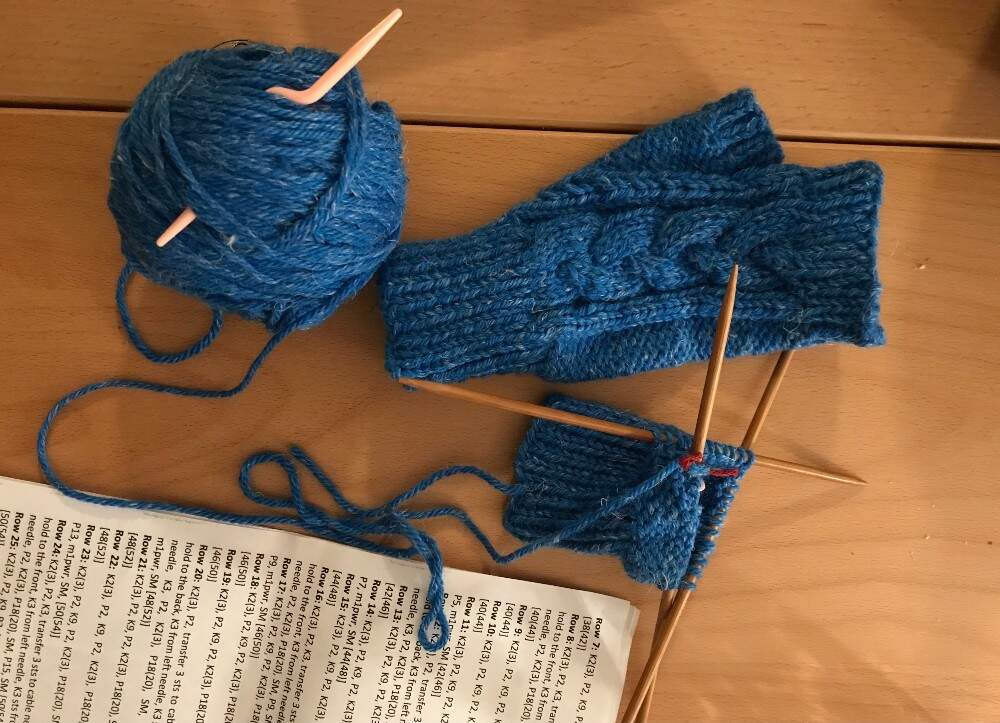
I don’t know if the other beginner took her advice, but I did. I downloaded a pattern for fingerless gloves decorated with intricate cable stitching. The gloves were far beyond my skill level. In service of the project, I watched videos on loop; I pored over library books decoding pattern terminology. I focused on the process of making, rather than the outcome. Mistakes were frustrating, but also an opportunity to learn how to solve the problems I’d made for myself.
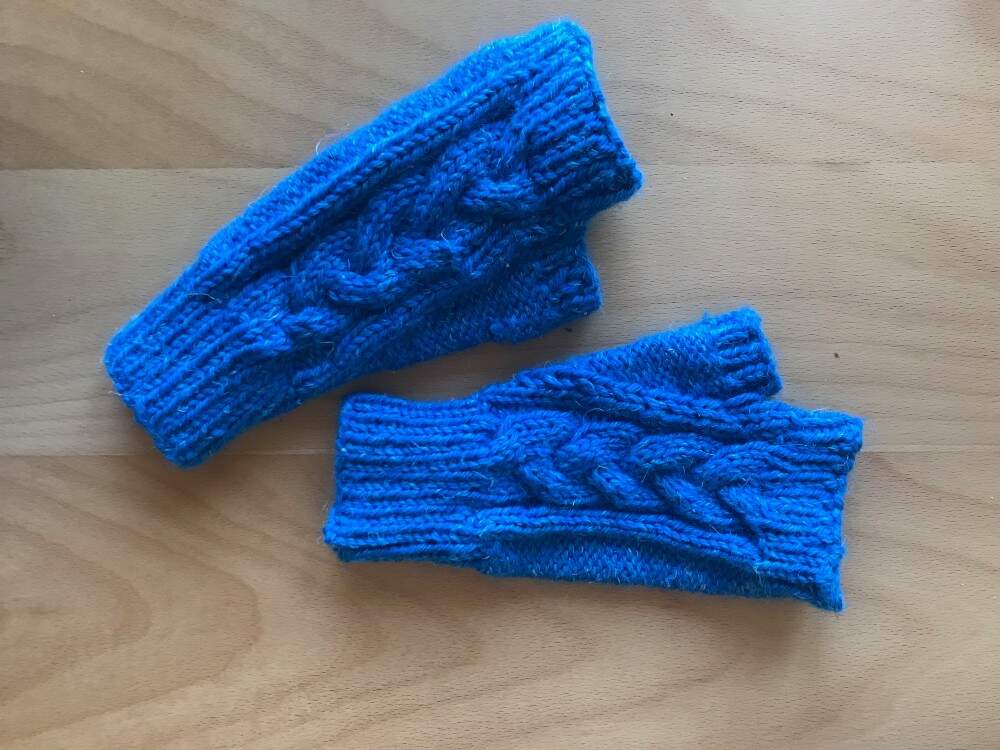
It took time for the pattern to emerge; at first, the stitches looked like they wouldn’t add up to anything. But the yarn — a cobalt blue threaded with flecks of white — was vibrant and soft under my fingers, and I kept going. When the gloves were finished, I was astonished that I’d really made them. The cable pattern on the back was braided and intricate, even if it was a little off-center. The rib-stitch border was elegant and consistent, even though the rows weren’t entirely straight. When I slipped on the gloves to fetch bagels, they fit well and kept me warm, despite the unravelling thread in the thumb gusset.
I focused on the process of making, rather than the outcome.
Those lumpy, flawed gloves made me excited to experiment again. As I knitted, I remembered the thrill of embarking on a project without knowing what it would become, or if I would have the skills to pull it off. Mistakes were inevitable. Irregularities were unavoidable. The pleasure was in choosing an ambitious project fearlessly, in giving it a shot.
That spring, I began to write again. I wrote the way I knitted: on the couch, feet under a blanket, cup of tea within arm’s reach. I tried to dream big. I tried not to worry about the finished product and the inevitable mistakes.
Five years later, I still wear the gloves I made that winter (and still pick at that loose thread). In the years since making them, I’ve taken many leaps into the unknown. I moved from New York to Texas to pursue a PhD, where I made new friends and began new stories set in that unfamiliar landscape. My boyfriend and I traveled abroad, adopted a tortoiseshell cat, and — this fall — got engaged. I began to teach writing again, and to publish my first short stories.
These years have been full of uncertainty, change, and big decisions. Often, I’m overwhelmed by the unknown, whether I’m deliberating about wedding venues, struggling with novel writing, disoriented in a new city or confronting a loved one’s unexpected illness. In those moments, I think back on the winter when I learned to knit. I try to approach unknowns, large and small, with optimism. I remind myself to simply begin — even if beginnings are messy, even if the outcome can’t be predicted.
For now, I sit wrapped in a handmade sweater, knitting a burnt-orange fisherman’s rib cowl, and give myself two responsibilities for the new year. First: trust the vision; let it excite you. Then: follow the thread.