Support WBUR
One ex-immigration judge in Mass. recounts her firing
Judge Nina Froes was on the bench last Friday, hearing a case at Chelmsford immigration court, when the email alert flashed on her screen.
"I could see what the subject line was," Froes recalled. Taking in the news, all she could think was, "OK, well, that happened."
The email said the U.S. attorney general's office was ending her appointment as an immigration judge. It was days before her two-year probationary period was over. She was ordered to hand in any government property and leave the post immediately.
Froes had been named a judge in May 2024, and gave up her immigration law practice in New Bedford to serve on the newly opened Chelmsford court. She said her legal background defending immigrants could be a factor in her dismissal — but she was not given a reason.
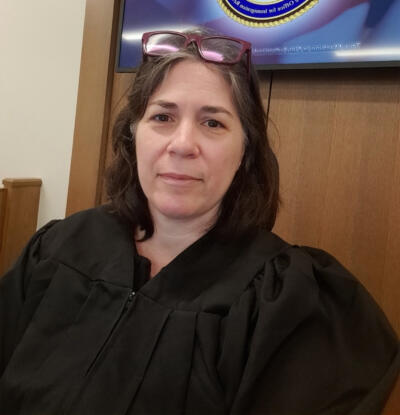
“ Is it because I'm a female? Is it because I'm older? Is it because I'm a Brazilian American? I have no idea,” she said. “And I think that's something that, at some point, may be the subject of litigation, and so I would hate to speculate about it.”
Federal immigration courts fall under the auspices of the Department of Justice. They're considered administrative, not judicial, giving the executive branch more power over their operation compared to other federal courts.
The Justice Department under President Trump has fired more than 100 judges appointed under former President Joe Biden, including three in Massachusetts. Two of whom served as defense attorneys for immigrants.
Froes and two other Massachusetts judges were fired in the latest round of dismissals from U.S. immigration courts. Early in her tenure, she served alongside 19 judges in Chelmsford; now the court has just five permanent and two temporary judges.
A spokesperson for the Justice Department’s Executive Office for Immigration Review, which oversees the courts, declined to comment on the Massachusetts judges dismissed Friday, but said in a statement that if a judge demonstrates systematic bias, the office “is obligated to take action.”
Two months before her firing, Froes had ruled against deporting activist Mohsen Mahdawi, a Columbia University student who led pro-Palestinian protests at the school in 2023 and 2024. The government portrays Mahdawi as a terrorist sympathizer and is still looking to deport him.
Roopal Patel, a Boston immigration judge, also was fired Friday. She ruled against the deportation of Rümeysa Öztürk, a Tufts University grad student who wrote an op-ed against the war in Gaza.
"The administration is firing judges at the end of their probationary period if they were hired in the Biden administration and had previously represented immigrants," Patel said in a statement. "I think I would have been fired no matter how I ruled in the Öztürk case."
Federal officials deny that these cases had any role in the firing of the judges. But some court observers argue that the Trump administration is stacking the courts to push its mass deportation agenda.
In this atmosphere, Froes said morale at the Chelmsford immigration court is “terrible.” Under the Trump administration, her caseload skyrocketed — at one point reaching 15,000 cases that had to be scheduled several years out.
Froes said a slew of staff departures has led to “a perennial going away party” in the court lunchroom.
“We have this sign, it's a banner and it says, ‘We will miss you,’ and it has been up on the wall [for] almost a year,” she said. “It just stays there. Nobody takes it down.”
Judge Erin Gover confirmed she was the third Massachusetts immigration judge fired Friday. She previously served as an assistant corporation counsel, and then an assistant borough chief and deputy borough chief with the New York City Law Department.
The trio was part of a class of 18 judges appointed in May 2024 by the Biden administration. The Biden hires included lawyers from diverse legal backgrounds, including seven former ICE lawyers and six who'd worked as immigration lawyers, according to DOJ data.
Compare that with the most recent hirings under Trump. In March, the DOJ announced 42 new judges, none of whom had worked as an immigration lawyer. Fifteen came from ICE; three served as military lawyers; and others came from law enforcement and military backgrounds, according to a WBUR analysis of federal bulletins.
One of the new judges, Robyn Ross in Colorado, had neither military nor government experience. She was research director at Children’s Health Defense, a “vaccine safety” group founded by Robert F. Kennedy Jr., who is now secretary of U.S. Department of Health and Human Services.
If the new cast of judges is part of Trump's mass deportation agenda, Froes isn’t sure it will have the desired effect.
“ Everybody looks to be highly qualified,” she said. “Yes, they do seem to have a lot of military experience. They do seem to have a lot of DHS experience. But that to me does not mean one thing or the other about their political leanings.”
The dismissal of judges comes as immigration arrests in Massachusetts have seen a nearly five-fold increase.
The total number of immigration judges has fallen from 750 to roughly 600, including voluntary departures, firings and new hires, according to the National Association of Immigration Judges. That's a 22% decrease since the start of Trump's second presidency, even as the White House ramps up detentions.
Andrew Arthur, a retired immigration judge and analyst with the conservative Center for Immigration Studies, said there's definitely room to hire more judges. But there’s a caveat. Arthur said more cases are now being heard involving people in ICE custody — the so-called “detained docket.” And those cases are processed in a fraction of the time it takes to handle other cases.
“And so consequently, you need fewer judges on the bench,” Arthur said. “You basically just need to keep the assembly line going as they come in.”
One of the biggest changes under this administration was a directive that judges deny bond hearings to anyone who entered the country illegally. Arthur said that policy is rooted in immigration law.
For Froes, the mandatory detention order was hard to accept. But it was part of the job. She said if she'd believed that policy or any others violated ethical rules, she would have quit.
Instead, it was the government that decided she was out.
Now, like tens of thousands of other federal workers sacked by the Trump administration, Froes is applying for unemployment — and considering her next chapter.
Correction: This story has been updated to correct the spelling of Judge Erin Gover's last name and details of her prior work experience. We regret the errors.
This segment aired on April 16, 2026.